
How do real estate agents use social media to generate leads?
- How does social media actually create real estate leads?
- Which posts turn attention into buyer or seller conversations?
- How should agents review social lead content before publishing?
- What tools and resources should support social lead generation?
- Where does RealEstateContent.ai fit into the workflow?
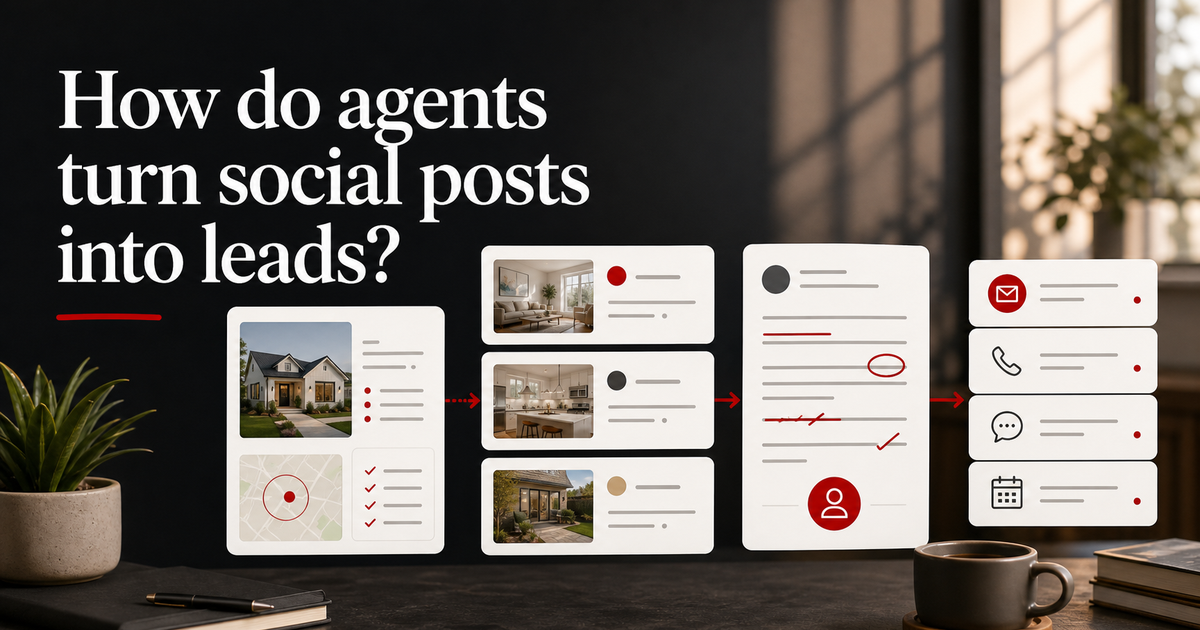
Real estate agents generate leads on social media by publishing useful, source-backed posts that answer buyer and seller questions, then routing interested people to one clear next step. The content works best when listing facts, market context, compliance review, and follow-up handling are planned before posting.
On this page
Table of contents
- How does social media actually create real estate leads?
- Which posts turn attention into buyer or seller conversations?
- How should agents review social lead content before publishing?
- What tools and resources should support social lead generation?
- Where does RealEstateContent.ai fit into the workflow?
How does social media actually create real estate leads?
Social media creates real estate leads when a post gives someone a reason to ask a concrete next question. The best posts do not chase generic engagement. They answer a buyer, seller, neighborhood, listing, or timing question and make the next step simple enough to take.
That means a lead post needs three parts: a useful reason to stop, a trustworthy source of truth, and a follow-up path. A listing post can invite a showing. A seller post can offer a pricing conversation. A market update can route readers toward a local context question. NAR technology research shows why this matters: social media and AI-generated content are already active parts of agent work. Source: NAR technology survey.
| Lead ingredient | What it does | Review question |
|---|---|---|
| Verified source fact | Keeps the post grounded in listing, market, or event truth | Is the claim supported by the source packet? |
| Reader-specific question | Gives a buyer or seller a reason to respond | What question would this post help them ask? |
| Follow-up route | Turns attention into an agent action | Where should a comment, DM, or click go next? |
The point is not to turn every post into a hard sell. It is to help the right person self-identify. A buyer who asks about monthly costs, an owner who asks about timing, or a neighbor who wants the open-house details has moved beyond passive scrolling.
Social Media Lead Generation cluster
A practical cluster for agents who want social posts to create real buyer and seller conversations. It connects source-backed post ideas, platform-specific angles, Fair Housing review, and follow-up routing into one repeatable RealEstateContent.ai workflow.
3 spoke guides · ~18 min each · last updated 2026-05-25Which posts turn attention into buyer or seller conversations?
The strongest lead posts answer one immediate question: what is available, what is changing, what should I consider, or what should I do next? Listing launches, open-house reminders, seller checklists, buyer Q&A posts, and market updates work because they connect content to a real decision.
A Facebook post can start a community conversation around a listing or open house. An Instagram post can turn one visual detail into a question sticker, saved carousel, or direct message. A market update can explain what changed locally without pretending the post is a full valuation. Each format has a job.
- 01
Choose the lead moment.
Pick the buyer, seller, event, or listing question the post will answer.
- 02
Attach approved facts.
Use the listing source, market note, event detail, or seller-approved angle before drafting.
- 03
Write one next step.
Match the CTA to the question: ask for the packet, request the floor plan, message for showing details, or read the related guide.
- 04
Prepare the response path.
Decide who replies, what information they can send, and when the post needs to be updated.
Agents should also be careful with proof and advertising language. FTC guidance expects advertising claims to be truthful and not misleading, which applies to social copy when the post makes an objective claim about service, results, pricing, or property facts. Source: FTC truth in advertising.
How should agents review social lead content before publishing?
Agents should review social lead content for accuracy, inclusivity, claim support, image permissions, and next-step clarity before it goes live. A quick review catches the problems that make content feel automated: unsupported claims, vague urgency, risky audience language, and CTAs that do not match the actual route.
The review should be practical, not legalistic. It should ask whether the post describes the property rather than the preferred resident, whether timing and availability are current, and whether any market or pricing statement is source-backed. HUD guidance explains that online housing-related advertising still sits inside Fair Housing obligations. Source: HUD digital advertising guidance.
A useful review pass checks:
- whether the post describes verified property or market facts;
- whether the CTA matches the actual destination;
- whether audience language avoids steering or protected-class implications;
- whether images and captions describe the same approved information;
- whether the follow-up owner knows what to do after someone responds.
That keeps the page's advice realistic for working agents. Lead generation improves when the post, the review pass, and the follow-up system are designed together.
What tools and resources should support social lead generation?
A strong social lead system needs a source packet, a review checklist, a routing plan, and a simple way to reuse approved ideas. The tools do not need to be complicated. They need to keep facts, images, CTAs, and follow-up owners visible before a post is published.
Useful resources include the approved listing record, event details, recent market notes, platform draft cards, a Fair Housing language checklist, and the route where each CTA should send a reader. NAR provides the digital marketing context, while FTC and HUD sources define the claim and advertising review boundaries that keep the workflow practical.
| Resource | Why it matters | Where it shows up |
|---|---|---|
| Listing or market source packet | Prevents unsupported claims | Captions, carousels, and landing-page copy |
| Review checklist | Catches risky wording before publishing | Agent approval workflow |
| CTA route map | Keeps every post connected to a real next step | Related pages and landing pages |
| Follow-up owner | Turns comments, DMs, and clicks into action | CRM notes or response queue |
The resource layer also makes the three sub-guides easier to use together. Facebook, Instagram, and open-house posts can each have different formats, but they should draw from the same verified facts and the same follow-up rules.
Tools & resources
- GUIDE NAR technology survey Source for agent social media, AI-generated content, and real estate technology adoption context.
- GUIDE HUD digital advertising guidance Source for digital housing-ad language, targeting, and Fair Housing review boundaries.
- GUIDE DOJ Meta housing advertising case Source for why housing-ad targeting and delivery systems need extra review.
- GUIDE FTC truth in advertising Source for truthful advertising, objective claim support, and non-misleading social copy.
- GUIDE FTC endorsement guides Source for testimonial, endorsement, and relationship-disclosure boundaries.
Where does RealEstateContent.ai fit into the workflow?
RealEstateContent.ai fits between approved source material and the agent's final publishing decision. It helps turn listing facts, market notes, open-house details, and buyer or seller prompts into draft social content, then keeps the human review step visible before anything becomes public.
That matters because the hard part is not writing one post. The hard part is repeating the workflow without losing accuracy, voice, or compliance judgment. RealEstateContent.ai should help agents create a repeatable content system while still keeping claims, CTAs, and sensitive language under review.
In this smaller Campaign, the pillar points to three practical sub-guides: Facebook lead posts, Instagram lead content, and open-house social promotion. The two landing pages then translate the same strategy into conversion paths for planning lead content and generating lead post drafts from approved facts.
Frequently asked questions
Questions brokerages and agents ask in the first 90 days of adopting AI-assisted listing marketing. These mirror the FAQPage schema in the page head — AI crawlers can lift the Q/A pairs directly.
What kind of social posts generate real estate leads?
Posts that answer a real buyer or seller question generate better leads than generic activity posts. Listing launches, open-house reminders, market updates, pricing prompts, and buyer Q&A posts work when they include one useful answer and one clear next step.
Should agents post listings or educational content?
Agents usually need both. Listings create immediate property interest, while educational posts build trust with people who are not ready to book a showing. A balanced plan connects both types to the same follow-up system.
How often should agents post for lead generation?
Post often enough to stay visible, but do not force filler. A practical cadence is built from actual listing activity, market changes, buyer questions, seller objections, and community events rather than a fixed daily quota.
Can AI write real estate social posts safely?
AI can draft useful options when it starts from approved facts and stays behind human review. The agent still needs to confirm listing details, image permissions, Fair Housing language, claims, tone, and CTA accuracy before publishing.
What makes a social media lead worth following up with?
A lead is worth follow-up when the person asks a property, timing, price, neighborhood, or process question. Likes alone are weak signals. Comments, replies, saved-post conversations, and direct requests deserve a clearer response path.
How should social posts link back to the website?
Each post should send people to the most relevant next step: a listing page, open-house details, a market note, a seller consultation, or a RealEstateContent.ai workflow page. Avoid generic home-page links when the post has a specific promise.
What should agents avoid in lead-generation posts?
Avoid fake urgency, unsupported results, protected-class assumptions, vague lifestyle claims, copied captions, and CTAs that lead nowhere. The post should make the agent easier to trust, not busier to police after publishing.
Where should agents start if they have no plan?
Start with one listing, one buyer question, one seller question, one market update, and one follow-up CTA. That gives the agent a simple weekly pattern before adding more platform-specific variations.
Key takeaways
- Leads start with useful questions Social posts work when they answer a buyer or seller question and make the next step obvious.
- Review protects trust Listing facts, fair housing language, proof claims, and CTA destinations should be checked before publishing.
- RealEstateContent.ai supports repeatability RealEstateContent.ai helps agents turn approved facts into platform-ready drafts without removing human approval.

What should real estate agents post on Facebook to generate leads?
Facebook post ideas that turn local attention into showing, seller, and follow-up conversations.
 · Founder, RealEstateContent.ai
How can real estate agents get leads from Instagram?
Instagram formats for turning visuals, stories, and captions into real estate lead signals.
· Founder, RealEstateContent.ai 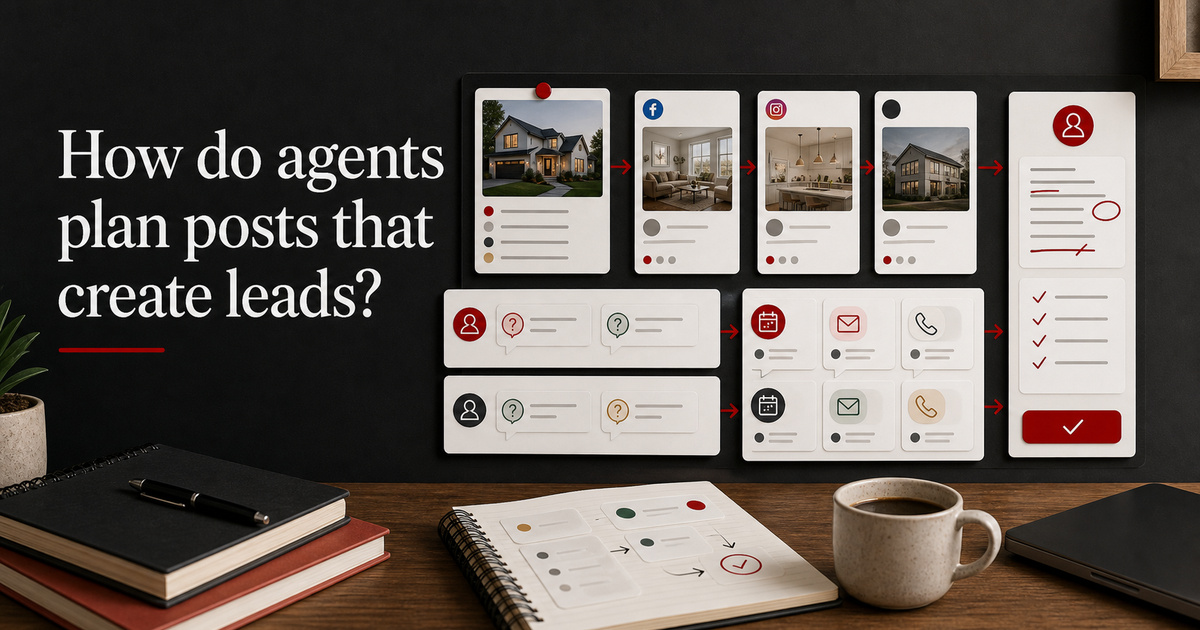
Plan real estate social posts that create better leads
RealEstateContent.ai workflow for planning source-backed social posts with clear CTAs.
· Founder, RealEstateContent.ai