

How to Build a Content System That Runs on Autopilot: 7 Steps for Consistent Real Estate Marketing
Last updated: Oct 28, 2025
Real talk: consistency isn’t your problem—manual work is. Most agents I work with have plenty to say about their market, listings, and clients. The bottleneck is turning that expertise into consistent real estate social media marketing without spending nights formatting posts and juggling five apps.
Here’s the thing
Let’s make this manageable. You don’t need to be an influencer or hire a media team. You need a repeatable, automated content system for real estate that runs off one weekly source and distributes everywhere. You probably already have everything you need—a phone camera, a few recent listings or market insights, and a calendar. The key is connecting these pieces into a working system.
After helping hundreds of real estate professionals build this exact setup, here’s what I’ve learned: the agents who win keep it simple, document their flow, and let social media automation handle the grunt work. One of our top performers went from posting twice a month to publishing five pieces weekly across Instagram, Facebook, LinkedIn, YouTube Shorts, and email—boosting inbound messages by 38% and cutting content time from six hours to 90 minutes per week. No heroics, just a reliable property content strategy with smart automation.
What You’ll Learn
-
How to design an automated content system real estate teams can maintain without a media department
-
A simple repurposing engine that turns one weekly source into multi-channel posts, emails, and lead magnets
-
The exact automations to set up for real estate content scheduling and distribution that save hours each week
-
How to measure and maintain performance without heavy reporting or analysis paralysis
Let’s build your system
Before we dive in: you don’t need a perfect setup. The key is a simple, documented flow you can stick with—supported by light automation and reusable templates.
I’ll walk you through each step so it feels practical and doable this week, not “someday when things slow down.”
Your 7-Step Autopilot Content System
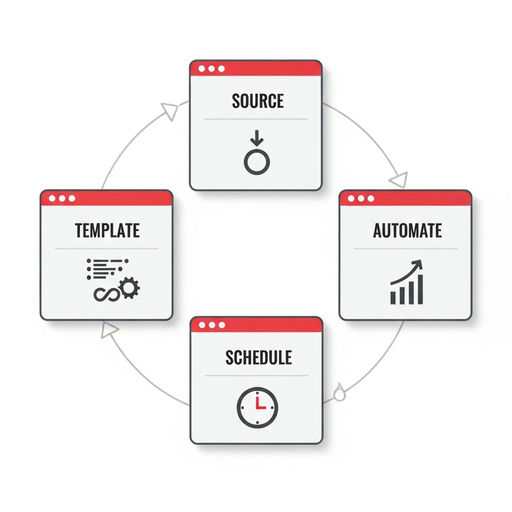
A high-level look at the flow we’ll build: one reliable source feeding every channel, measured and maintained with quick weekly habits.
Choose Your Weekly Core Source and Pillars (15 minutes)
Pick one Core Source you can create every week without fail. For most agents, a five to eight minute talking-head video works best because it’s fast to record and easy to repurpose. Focus on market updates, neighborhood highlights, or common buyer and seller myths—then set three pillars to guide your topics: Market Education, Local Lifestyle, and Proof of Work. If you prefer writing, start with a short blog or email and convert it to video later; the right medium is the one you can produce consistently. If you want more structure, explore planning ideas and a simple calendar template in this content calendar guide.
The goal is repeatability. Once your Core Source is locked, every other piece of content becomes a remix rather than a fresh start, which is exactly how you stay consistent without spending all week on content.
Create a Lightweight Content Calendar and Naming System (20 minutes)
Build a single view of your next four weeks using Google Sheets, Notion, or Airtable—whatever you’ll actually open. Keep columns simple: publish date, channel, pillar, asset link, status, and CTA. Add a clean file naming convention so assets stay organized, like 2025-10-28_market-update_inventory-shift_master.mp4. This tiny system makes automation, content scheduling, and future real estate content repurposing dramatically easier. If you need a starter template, use the simple structure from our planning walkthrough here: social media content planning for realtors.
Think of this as your map. When your week gets busy, your calendar and naming system help you pick up right where you left off without hunting through folders or rewriting captions from scratch.
Build Your Repurposing Recipe: 1 Source → 5 Outputs (40 minutes)
Record one Core Source each week, then transform it into multiple assets in a single sitting. Start by pulling two to three short clips for Instagram Reels, TikTok, and YouTube Shorts. From the same source, draft a LinkedIn text post or article that focuses on one strong insight. Turn your key points into an Instagram carousel or a Facebook photo album—property photos and neighborhood visuals work well here. Finally, create a short email snippet that links back to your full video or blog so your database stays warm.
You don’t need fancy tools. CapCut or Descript handle clipping, Canva makes carousels and thumbnails fast, and any email platform will do for distribution. Keep your calls-to-action consistent and aligned with real estate lead generation, like a buyer guide, a neighborhood report, or a market update subscription. When you want a proven approach, use the simple outline of hook, three insights, and a clear CTA. For a deeper dive, see our repurposing framework: turn one video into 12 posts.
Set Up Folder Automation and Templates One Time (25 minutes)
Create a “Content Engine” folder with simple subfolders like 00_Master, 01_Clips, 02_Thumbnails, 03_Captions, 04_Scheduled, and 05_Archive. Save reusable templates for captions, carousel layouts, thumbnail styles, and email intros so every new piece starts 80% done. Then add light automation: when you drop a new master video into 00_Master, let a Zapier or Make scenario create a new calendar row, generate a task list, and populate placeholder captions. This is practical real estate marketing automation that reduces context switching and makes your process feel organized even on your busiest weeks. For a plug-and-play stack and file flow, use our integration guide: automation stack for agents.
Do this setup once and you’ll feel it every week—fewer clicks, fewer decisions, and a smoother handoff if you ever delegate parts of the workflow.
From Core Source to Multi-Channel Distribution

This is the “engine room” of your system—templates plus light automation turn one recording into a full week of content.
Schedule Once Per Week with Smart Defaults (30 minutes)
Block a single 30-minute window to schedule everything so publishing never depends on your mood. Use Buffer, Later, or Metricool—whichever you’ll actually use—and set channel defaults so you never start from a blank screen. For Instagram Reels, keep two to three local hashtags and a “save this for later” CTA ready to go. On Facebook, keep captions short and link to the full post or property page. On LinkedIn, format with clear spacing and include one professional insight. For YouTube Shorts, write a descriptive title with your local market keywords. In email, summarize with three quick highlights, one link, and a soft CTA.
Establish a weekly rhythm that fits your market—think Monday Reels, Tuesday LinkedIn, Wednesday Carousel, Thursday Email, Friday Shorts. Once defaults are set, distribution feels effortless. For a structured walkthrough of scheduling patterns, visit how to schedule real estate social posts.
Add Measurement That Informs, Not Overwhelms (15 minutes)
Track only what helps you improve next week. Keep it simple with weekly counts of how many posts you shipped per channel, a quick scan of engagement rate to see what resonates, and link clicks or replies to gauge intent. Note your top three performing topics and use them to shape next month’s plan. Then, run a short monthly content audit to identify high performers worth repackaging, refreshing hooks, or converting into an infographic-style recap featured in your short-form strategy. That’s how you stretch each idea further without burning out.
When you want a lightweight framework, this guide shows exactly how to review repurposed content without drowning in metrics: measure real estate content performance. For additional short-form content angles, explore infographic creation and short-form tips for real estate.
Close the Loop with Lead Capture and CRM Integration (20 minutes)
Every post should lead somewhere useful. Create a single destination page with simple audience paths like a buyer guide, seller timeline, new construction list, neighborhood alerts, or a monthly market update. Add UTM links so you can see exactly which channel drives results. Connect forms to your CRM so contacts get the right drip immediately—this is the bridge between social media engagement and real pipeline. If you prefer one clean path, offer “Get my local market update” and deliver a short monthly email plus a quarterly deep dive. For nurture structure and newsletter prompts, use these ideas: real estate newsletter ideas.
Once this loop is active, your content isn’t just consistent—it compounds, because each interaction guides people toward the next best step.
When Real Life Gets Messy
Things will go sideways—travel, listings, tool updates, you name it. The difference between agents who sustain momentum and those who stall is a minimum viable system that keeps running even on hectic weeks.
Here are the most common speedbumps I see and the fixes that keep you moving:
Common Speedbumps (And How to Glide Past Them)
😅 I do not like being on camera
No problem at all! Start with written Core Sources and narrate slideshows or screen shares with a small face-cam. Use property virtual tours with voiceovers to build confidence, then record 60-second tips from your car before a showing. Consistency first, polish later.
🤔 I feel repetitive posting the same ideas
Good—that’s how your market remembers you. Repurpose by changing the angle: turn one topic into a myth buster, a checklist, a client story, and a neighborhood comparison. Space repeats four to six weeks apart, refresh the hook and thumbnail, and watch recognition rise.
📅 My schedule blows up and I skip weeks
Create a two-week evergreen buffer. Record two short educational videos and design two timeless carousels that are always relevant. When life gets busy, schedule from the buffer so your public consistency never slips.
🔧 The tech stack feels heavy
Use the minimum: one calendar, one design tool, one scheduler. Add automation only for tasks you repeat three or more times. Keep everything in a single workspace to reduce context switching and confusion.
📈 I am not seeing leads yet
Lead indicators show up first—more saves, shares, replies, and profile visits mean the engine is working. Tighten your CTAs, pin your lead magnet, and DM warm engagers. Expect six to twelve weeks for consistent real estate lead generation.
The Principles That Keep It Running
Your automated content engine doesn’t need to be perfect—it needs to be repeatable, lightly automated, and focused on real questions your market actually asks.
Lock in these core principles; they’re what separate a one-month sprint from a system that compounds all year.
Your Five Core Operating Principles

These principles keep your content engine consistent, sustainable, and clearly tied to pipeline.
5 Principles That Keep Your System Running
This is what I see separate the agents who sustain a year of consistent publishing from those who flame out after a month.
-
Start with one weekly Core Source and three pillars to avoid decision fatigue
-
Template everything once so content creation becomes drag-and-drop
-
Automate only the repeats to reduce errors without adding complexity
-
Schedule in one weekly block so publishing never depends on your mood
-
Measure lightly so you keep improving without stalling in analysis
Your Next Best Step
Ready for a quick win? Choose your Core Source, set three pillars, and build one repurposing template today—everything else gets easier once those are in place.
If you want deeper playbooks, these resources walk you through the automations, repurposing, and scheduling patterns we covered here.
Helpful Resources