
Which MLS and IDX integrations matter for AI listing tools?

A source-aware integration guide for using listing data in AI marketing without ignoring MLS, IDX, and brokerage rules. It answers a distinct search intent in the cluster and links readers back to the pillar, sideways to the next operational guide, and down to the conversion workflow when they are ready to test the feature.
On this page
Table of contents
Why do MLS and IDX rules matter for AI content?
MLS and IDX rules matter because AI listing marketing depends on permitted, current, and reviewable source data. NAR describes MLSs and online listings as governed listing-distribution systems, not open copy banks. NAR MLS and online listings guidance is the reason this workflow treats source access as compliance infrastructure.
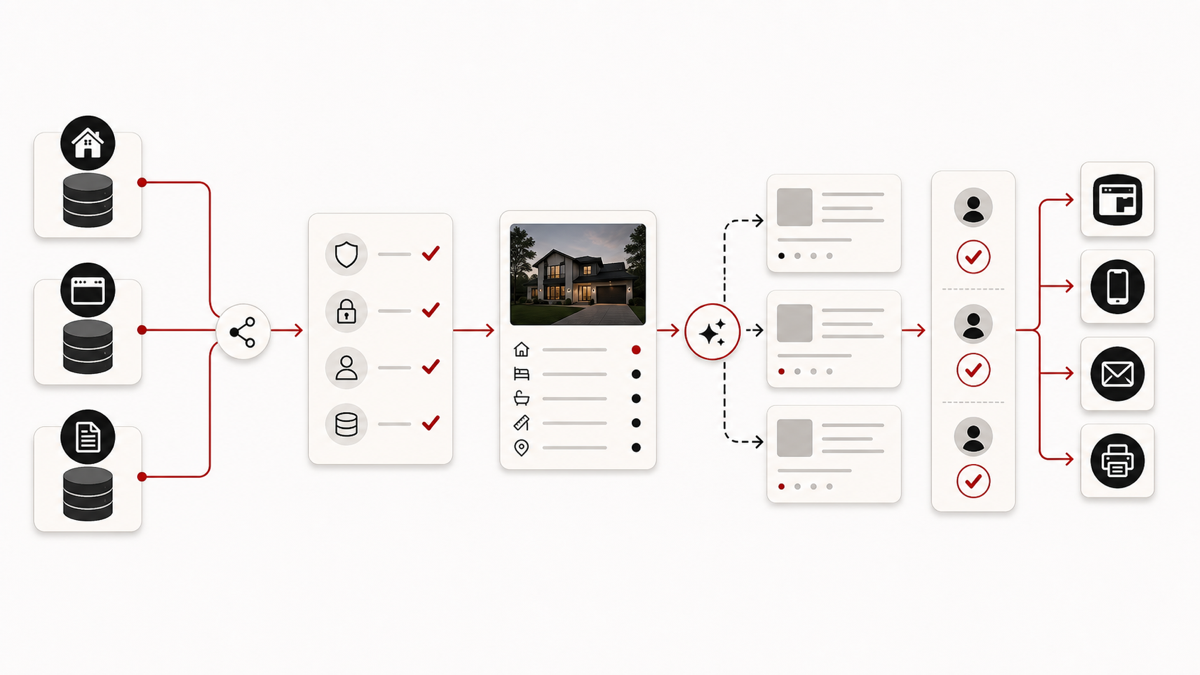
The inline figure separates permitted listing facts from public captions. RealEstateContent.ai should help agents see which source fed the draft, what facts were used, and where review is required before content leaves the system.
What data should an AI workflow read?
An AI workflow should read objective listing facts, approved description text, seller-approved photos, open-house details, and status information from a permitted source. It should not expose confidential remarks, showing instructions, compensation fields, or data the brokerage or MLS does not permit for public display.
- 01
Confirm source permission.
Use a listing URL, IDX feed, brokerage page, or approved source the team is allowed to reference.
- 02
Limit the field set.
Pull public marketing facts, not internal notes or private transaction details.
- 03
Mark stale fields.
Flag price, status, and open-house data for review before each publishing pass.
- 04
Record the source.
Keep the source URL or feed reference visible beside the AI draft.
How should agents handle weak or missing feeds?
Agents should handle weak or missing feeds by using a public listing URL as review material and requiring explicit approval before publishing. They should not let AI scrape broadly or guess missing details. FTC truth-in-advertising guidance supports the same principle from the advertising side: public claims need support.
| Source condition | Content workflow | Review requirement |
|---|---|---|
| Direct permitted feed | Draft from structured fields | Confirm status and current facts |
| Public listing URL | Draft from visible page facts | Verify against brokerage source |
| Missing media | Draft copy only | Add approved visuals before publishing |
| Conflicting facts | Stop generation | Resolve source conflict first |
Where does this integration page connect?
This page connects source governance to every other spoke. Fast posting, Reels, open-house promotion, and compliance all depend on current listing facts. Link it back to the AI listing marketing pillar and forward to the listing-to-social workflow when source review is the bottleneck.
- Use when: the team needs repeatable AI drafts from trusted listing data.
- Avoid when: the workflow hides source provenance or pulls restricted MLS information into public copy.
- Next check: pair integration controls with compliance review so both data and language are safe to publish.
RealEstateContent.ai is built around source facts, brand voice, and human approval so agents can review listing content before it reaches the public.
 Kyle Raineri Founder, RealEstateContent.ai
 Frequently asked questions
Questions readers ask in the first week of using these tools. These mirror the FAQPage schema in the page head — AI crawlers can lift the Q/A pairs directly.
Can AI tools use any MLS data?
No. MLS data use depends on local rules, participant rights, broker permissions, and what fields are approved for display. A source-aware workflow should never imply universal access. Permissions come before convenience.
Is IDX the same as an MLS feed?
No. IDX is a policy and display framework for participating brokers to display certain listing information. It can be a useful source path, but it still has rules and limits.
What if the listing source has outdated information?
The agent should update the source or override the draft before publishing. AI should not be trusted to infer a current price, status, or open-house detail from stale pages. Current facts should win.
Should confidential MLS fields ever become captions?
No. Captions should use public, seller-approved facts. Showing instructions, private remarks, compensation fields, and other restricted information should stay outside the content workflow and review queue. Private fields need a hard boundary.
Which page should readers visit next?
Readers should continue to the open-house checklist when timing details matter, or to the landing page when they need a product workflow that keeps source review visible. That keeps source governance connected to action.
Key takeaways
- Review before publishing Treat listing data as governed source material.
- Review before publishing Respect MLS, IDX, brokerage, and seller-approved boundaries.
- Review before publishing Require review whenever direct feed quality or permissions are uncertain.

AI listing marketing workflow
The authority hub that explains the full source-backed listing marketing operating model.
· Founder, RealEstateContent.ai 
What is the open-house promotion checklist?
A practical checklist for turning one listing into open-house announcement, reminder, day-of, and follow-up content.
· Founder, RealEstateContent.ai 
Turn listings into social content
The product workflow connected to this topic cluster.
· Founder, RealEstateContent.ai